China's GPU-less supercomputer is a warning
LineShine passed El Capitan on the TOP500 using only CPUs. It isn't the end of GPUs, or proof that sanctions failed on their own. It's a warning: when the Nvidia queue closes, architecture becomes geopolitics.
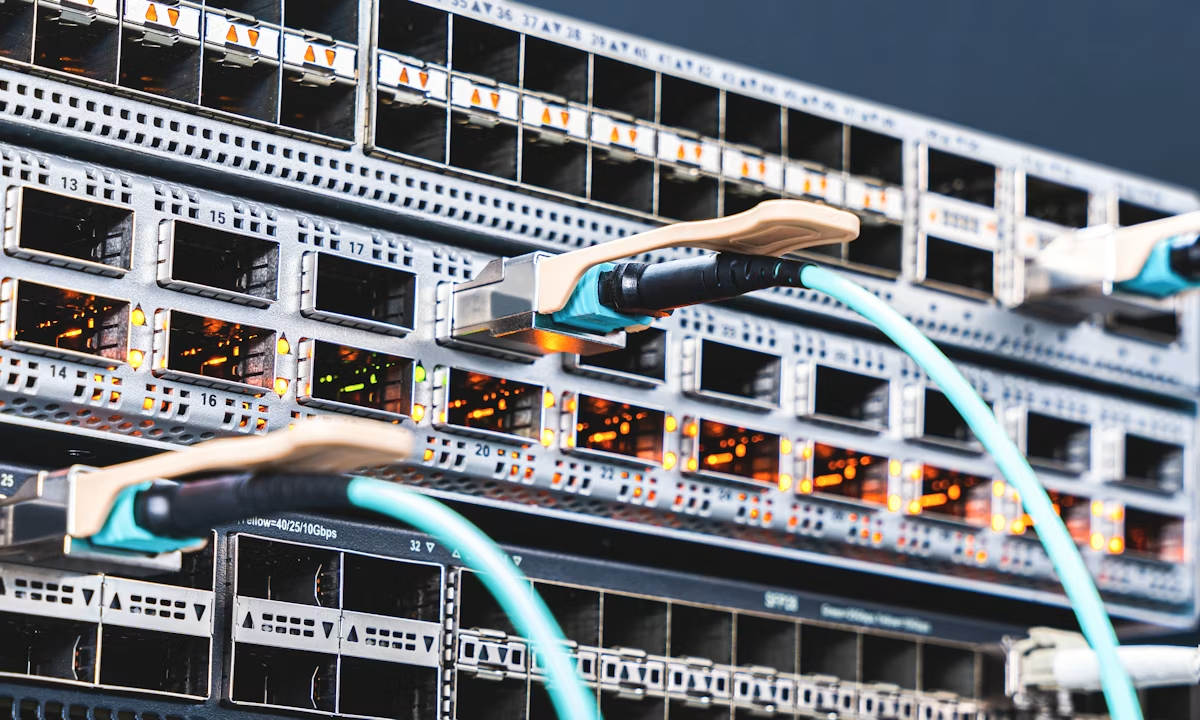
China is back at the top of supercomputing with a choice that looks almost anachronistic in the middle of the GPU boom. LineShine, installed at the National Supercomputer Center in Shenzhen, led the June 2026 TOP500 list with 2.198 exaFLOPS of sustained Linpack performance, above the U.S. El Capitan system.¹ ² The headline detail: it did it without GPUs.
Instead of the dominant recent model — CPU to orchestrate, GPU to crush parallel math — LineShine uses roughly 45,000 LX2 CPUs, each with 304 Armv9 cores at 1.55GHz, connected through a proprietary LingQi network.² ³ That adds up to almost 13.8 million cores. The system consumes about 42.2MW, compared with El Capitan's 29.7MW, and is less efficient.¹ ²
That doesn't mean China discovered GPUs are pointless. It means China built a machine designed to win a particular race with an architecture it could control.
The result matters because it runs straight into two stories we've already covered: the chip export ban and the new political queue at the AI frontier. When the United States tries to control who can buy GPUs, the answer doesn't only come through smuggling, lobbying, or commercial workarounds. It comes through architecture.
What TOP500 measures
TOP500 ranks supercomputers by HPL/Linpack, a double-precision linear algebra benchmark, the classic FP64 measure. It's useful because it gives a comparable gauge of brute force for scientific simulation, climate, physics, engineering, fluid dynamics, and other traditional HPC workloads.
But it doesn't measure everything that matters. A system can be excellent at Linpack and less impressive on HPCG, which stresses memory and communication. It can win at FP64 and lose badly at lower precision, where modern AI lives: FP16, BF16, INT8. It can be excellent for simulation and a poor choice for training a giant language model.
That's why the reading "China proved it doesn't need GPUs" is too simple. What LineShine proved is narrower and sharper: you can reach the public top of HPC with a purpose-built CPU-only architecture, without depending on Nvidia or AMD acceleration.
According to Tom's Hardware, LineShine also led the HPCG ranking with 22 PFLOPS, but its low-precision performance, 7.92 EFLOPS in FP16/BF16/INT8, doesn't beat large GPU-accelerated systems in the math that powers AI training and inference.² That changes the interpretation. LineShine is a scientific and geopolitical win. It isn't a giant H100 without H100s.
Why build it without GPUs
The GPU supercomputer path is familiar: buy top accelerators, fill racks, solve power, cooling, interconnect, and software. The problem for China is that top accelerators have become instruments of U.S. foreign policy. The country can't freely buy the best of Nvidia, AMD, or the ecosystem around those chips.
That leaves two strategies. One is to build local accelerators, as Huawei is trying to do with Ascend. The other is to use a more controllable and predictable component: domestic CPUs in absurd quantity, with memory and networking designed to extract the most from the set.
A CPU isn't weak by definition. It's less efficient than a GPU for certain parallel workloads, but it's flexible, programmable, strong at control flow, good with irregular tasks, and, when multiplied by tens of thousands of chips, an industrial instrument. LineShine doesn't compete with GPUs by imitating GPUs. It changes the question: what if the goal isn't to train the largest chatbot, but to show national autonomy in scientific supercomputing?
That detail explains the symbolism. The U.S. closed off a path to slow China in AI and HPC. China answered with a machine that doesn't use the component Washington controls most tightly. Even if efficiency is worse, the message is strong: restriction changes cost, it doesn't cancel ambition.
The cost shows up on the power bill
China's message didn't come free. 42.2MW is the consumption of a small city, and the number matters. El Capitan, using AMD MI300A accelerators, sits around 29.7MW.¹ ² If two machines do comparable work and one draws much more power, the second pays in electricity, cooling, and infrastructure.
That's the old truth of supercomputing: peak performance and efficiency rarely move together by accident. GPUs dominated not only because they're fast, but because they deliver a lot of compute per watt on parallel workloads. A CPU-only architecture has to compensate with scale, networking, memory, and software. LineShine managed it on the ranking; that doesn't make the strategy automatically better for every lab.
There's another cost: software. A supercomputer isn't a pile of chips. It's compilers, math libraries, operating system, scheduler, profiling, debugging, portability, and teams capable of adapting scientific code. The more proprietary the architecture, the more the ecosystem has to follow. A national machine can be powerful and still hard to use outside the centers that know it.
What this says about sanctions
Sanctions don't simply "work" or "fail." They change incentives. In chips, Washington reduced China's access to top GPUs, but also made it rational to spend billions on local alternatives. In the short term, that creates delays. Over longer periods, it forces learning.
Our export-ban piece showed the dilemma: blocking chips can hurt Nvidia, benefit Huawei, strengthen TSMC through other paths, and push countries toward their own supply chains. LineShine is another chapter. China may still depend on external bottlenecks in lithography, HBM, software, and advanced manufacturing, but the political direction is clear: less exposure to the American queue.
That's the point that matters for the rest of the world. A policy designed to control an adversary's access can fragment the whole market. Labs start optimizing for availability, not just benchmark performance. Countries buy what they can guarantee, not only what's technically best. Companies build local stacks so the next decree doesn't suddenly turn them into prohibited customers.
What about AI?
The temptation is to look at "2.198 exaFLOPS" and conclude China now has the world's best AI machine. That's not what happened.
Modern AI lives in low precision, memory bandwidth, accelerator-to-accelerator communication, and specialized software. GPUs and dedicated accelerators are excellent because they were optimized for matrix multiplication at scale, with tensor cores, HBM, and mature libraries. A CPU-only machine can run AI, of course, but it isn't automatically the best tool for training frontier models.
LineShine matters to AI in another way. First, HPC and AI are merging: scientific simulation uses neural networks; AI uses simulation to generate data; climate, biology, and materials research already combine both. Second, computational sovereignty matters even when the machine isn't ideal for LLMs. Local capacity for sensitive research, defense, climate, energy, and strategic science reduces dependence on a foreign supplier.
Third, the frontier is no longer only technical. As we argued in the piece on government control of AI models, access has become part of the race. Asking "which chip is fastest?" no longer settles anything. The question is "which chip can you buy, operate, and maintain if politics changes?"
The lesson for Brazil
Brazil isn't going to build a LineShine next year. But it should understand the message. Strategic computing isn't only buying GPUs when there's budget. It's energy, data centers, networking, people, software, contracts, and the ability to change routes when the shelf closes.
Our current position is fragile. We want AI data centers, climate research, bioinformatics, cyber defense, industry, banking, health care, and digital government. All of that depends on a silicon chain we don't control. When the U.S. and China fight, Brazil doesn't decide the queue. Brazil enters it.
That doesn't mean willing advanced lithography into existence. It means practical sovereignty: supporting national HPC centers, training people who understand architecture and scientific software, buying from more than one path, maintaining CPU and GPU capacity, using cloud when it makes sense, preserving local alternatives, and not treating "Nvidia is available" as a permanent assumption.
LineShine is less proof that CPUs beat GPUs than proof that total dependence becomes risk. China paid a lot to show it can still appear at the top when the standard path is blocked. Smaller countries don't need to copy the machine. They need to copy the lesson: critical infrastructure cannot depend on a single queue.
The ranking and the message
TOP500 is an imperfect scoreboard, but imperfect scoreboards still move politics. In 2026, first place returned to China with a machine that chose a different way to get there. The technical story is fascinating; the political story is more important.
If the objective was to show export controls impose costs on China, they do. If the objective was to prevent China from advancing in strategic computing, the story is less comfortable. Sanctions can delay access to the best chip. They can also accelerate the decision to build without it.
LineShine doesn't end the GPU era. It ends the idea that the compute race has only one track. From here on, the question won't be only who has the strongest accelerator. It will also be who can assemble the entire stack (chip, memory, network, energy, software, and policy) without asking permission every time the frontier moves.
Sources
- China claims the world's fastest supercomputer · The Verge · https://www.theverge.com/tech/958768/china-claims-the-worlds-fastest-supercomputer · 28/06/2026.
- China's LineShine supercomputer dethrones US' El Capitan, secures first place in Top 500 list · Tom's Hardware · https://www.tomshardware.com/tech-industry/supercomputers/chinas-lineshine-supercomputer-dethrones-us-el-capitan-secures-first-place-in-top-500-list-first-machine-in-the-rankings-to-sustain-more-than-2-exaflops-of-double-precision-performance-using-only-cpus · 27/06/2026.
Show 3 more sourcesHide sources
- China Defies US Restrictions and Builds the World's Fastest Supercomputer · Wired · https://www.wired.com/story/china-defies-us-restrictions-and-builds-the-worlds-fastest-supercomputer · 28/06/2026.
- Chinese supercomputer leapfrogs best US machines to be ranked world's fastest · Live Science · https://www.livescience.com/technology/computing/chinese-supercomputer-line-shine-leapfrogs-best-us-machines-to-be-ranked-worlds-fastest · 29/06/2026.
- TOP500 List - June 2026 · TOP500 · https://www.top500.org/lists/top500/2026/06/ · Jun/2026.
— Newsroom